We are pleased to feature Peter Kim, Executive Director of Glow Foundation as part of our series on education. Glow Foundation started when its founders "were struck with the harsh reality that many college-admitted students from low income families do not enroll in college due to financial hardships." They also found that many students were not aware of financial aid options and were frightened to borrow money.
Glow Foundation assist students from under-resourced communities:
* 80% are low income, eligible for free or reduced lunch
* 80% will be the first to attend college
* Nearly 100% are from cultural backgrounds historically under-represented in college (Hispanic, Pacific Islander, African American, multi-racial)
Peter Kim tells us more about Glow Foundation and his experience in the philanthropy sector:
1. Please share with us something about your past professional background.
For the past six years, I have worked in the philanthropy sector designing and implementing social venture funds and grantmaking programs on environmental, education, youth development and land use planning issues. Prior to that, I worked both domestically and internationally in environmental law and policy, partnerships and corporate business. Those experiences helped shape my metrics driven and collaborative approach to the nonprofit sector.
2. You recently joined Glow Foundation. What does Glow Foundation do?
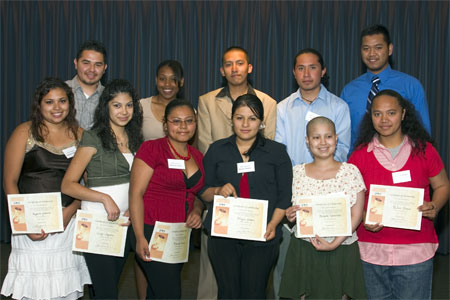
Glow Foundation is a 501(c)(3) that provides financial education, planning, mentorship programs, and scholarships to high potential, college ready students from low-income families. We support our students in developing basic financial skills allowing them to make informed and effective decisions about the use and management of money for the rest of their lives. Students gain critical financial skills and knowledge around budgeting, saving, spending, credit and loans in addition to understanding how they can fund their education by accessing various types of financial aid. Upshot is our programs help empower students to proactively create a budget, identify and seek funding to enter and graduate from college and use these skills as the foundation for lifelong financial stability.
Every year 200,000 low-income, college capable high school students graduate and do not pursue a college education. - College Summit 3. What do you hope to accomplish in the first 100 days there?
As the new Executive Director of the Glow Foundation, I want to leverage and strengthen our current partnership model to help more low-income students acquire basic financial skills to enter and graduate college. My focus will be on assessing and refining our metrics, evaluating program delivery, and meeting with potential strategic school and nonprofit partners to enhance our programmatic impact and reach. Concomitantly, I will look to develop long-term partnerships with corporations and financial institutions to secure sustaining funding channels and in return Glow Foundation will train, recruit and engage these companies’ employees in volunteer and mentorship opportunities. My first 100 days will be critical to building our internal organizational capacity and setting clear growth plans for the future.
 4. What are some of the major needs at Glow Foundation?
As a nonprofit start-up, Glow Foundation is constantly pounding the pavement for funding while refining programs to better serve more students. We are constantly trying to strike the balance between building a sustainable and stellar program versus scaling rapidly to reach more students. The more we reach the more funding dollars we can attract.
Our programs are in demand and there is a market appetite to scale as schools and nonprofits constantly approach us to partner and deliver our financial education and mentorship programs to their students. But we need to balance that against operational budget limits, staffing, and ensuring we grow a sustainable and stellar program.
5. Who are your go-to people for advice?
Over the years I have built up a small cadre of colleagues/friends from the public, private and nonprofit sectors that I consult on a regular basis to bounce off ideas and strategies. They are a diverse mix of lawyers, foundation and nonprofit leaders, corporate executives and government leaders. Serving as critical advisors, thought leaders, counselors, networkers, and sometimes partners, they provide me with a multi-sector perspective and approach to my nonprofit work.
Photos courtesy of Glow Foundation